

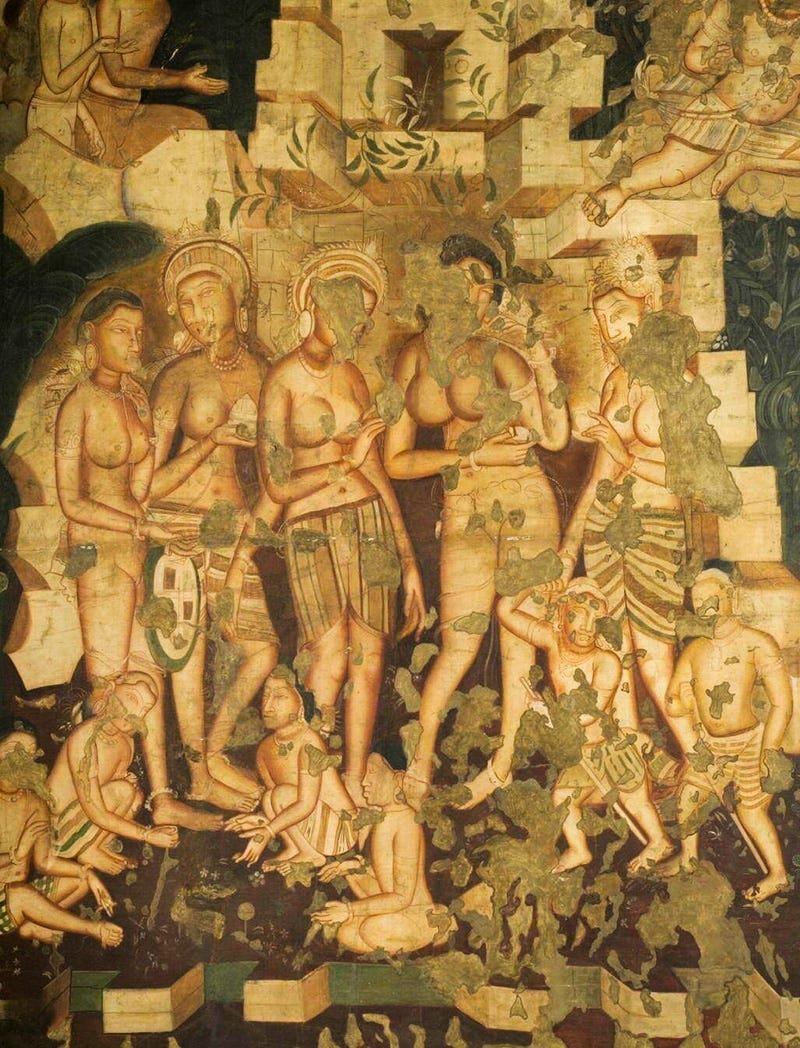
Indian painting brings me so much joy. In my time working in a museum, I’ve often had the pleasure of looking closely at art without the barrier of glass. The fineness of brushstrokes and the attention to detail reward repeat viewings. But even more, there is a sense of lush pleasure the artists imbue in the works. Spending time with the art, even without an art historian, is just joyful. How did they produce so much visual joy in their paintings?
This is the second half of the Introduction to Indian art through textiles. The first half is here. This is too long to email, so read online or in the app.
Art historians often split Indian art into two general categories: the first type is regional folk painting. Many of these paintings are stylistically specific to the region and to the culture. These works are often religious and sometimes ritual. The second large category of Indian painting is courtly art. For centuries, the South Asian subcontinent was ruled by Kings and often also by emperors. As with any court in the history of the world, art was used as a tool for displaying power and espousing refinement. But across all of these vast painting traditions over centuries, there are some very telling similarities. Again, let’s use textiles as the lens to understand the media. There are many elements of painting that go across time and faith. As we explore some of the highlights of painting from the subcontinent, I want you to consider some of the through lines in Indian painting. (This week I’ll focus on court painting, but I’ll pick up folk painting in another essay.)
Dynamism: Dynamism is an art historical term that doesn’t quite line up with how the word is used in common parlance. Somebody who is dynamic is engaging and exciting; the visual descriptor does create the same effect, but there are specific visual tricks that artists use. While I point out the specifics in the artworks below, the things to look for generally are when an artist chooses to use a diagonal line rather than a horizontal, when an artist chooses to frame a figure at an angle rather than straight on, and when an artist employs light in uneven ways rather than uniformly. Visual dynamism is achieved through calculating where and when you can add these elements to slow down the viewer or to heighten the narrative.
